What is Cybersigilism? The Futuristic Tattoo Trend Defined
original published date: Aug 25, 2025
major updated date: Aug 3, 2026

The world of body art evolves in tandem with technology, culture, and human self-expression. When looking at the top tattoo trends in 2026, cybersigilism stands as one of the most compelling blackwork movements of the decade. Fusing ancient esoteric iconography with glitch-art, Y2K cyber-grunge, and biomechanical aesthetics, cybersigilism transforms the human body into a living digital canvas.
Whether you are looking to collect your first piece or seeking a bold new aesthetic, understanding the technical precision, symbolic roots, and aging realities of cybersigilism is crucial before sitting in the chair. To ensure your piece maintains crisp, sharp geometry over time, booking with one of the top-rated tattoo shops in Columbus Ohio, is essential. At Burned Hearts Tattoo, our specialists excel at engineering a custom piece that flows organically with your body’s natural architecture.
Defining Cybersigilism: The Fusion of Tech & Magic
The word cybersigilism blends two distinct concepts:
Cyber: Referencing digital networks, circuit boards, cybernetics, and sci-fi technology.
Sigilism: The ancient practice of creating sigils—pictorial symbols charged with personal, spiritual, or ritualistic intent.
Unlike traditional heavy blackwork, cybersigilism is defined by extremely fine, spiky linework, flowing S-shaped curves, sharp razor-like nodes, and digital iconography like circuit traces or binary code.
| Feature | Technical & Aesthetic Profile |
|---|---|
| Primary Technique | Ultra-fine line blackwork using 1RL to 3RL needle groupings |
| Structural Forms | Spiky nodes, flowing S-curves, razor tips, and circuit geometry |
| Dimensional Shading | Micro whip-stippling, diluted grey-wash, and metallic 3D white highlights |
| Anatomical Flow | Engineered to accentuate muscle contours, the spine, and joint movement |
The Cultural Origins: Berlin, Sci-Fi & Y2K Aesthetics
To understand the roots of this movement, you have to look at the intersection of underground electronic music and sci-fi art. As documented by cultural design publications like 032c Magazine, cybersigilism originated in the late 2010s within the Berlin club scene before evolving into a global Gen Z phenomenon.
The visual language draws heavily from two distinct art movements:
H.R. Giger’s Biomechanical Art: The surreal, alien structures popularized by artist H.R. Giger in the film Alien established the concept of blending organic skeletal forms with synthetic machinery.
Extreme Metal Band Logos: The needle-thin, aggressive, and web-like logos created by artists like Christophe Szpajdel for black metal and death metal bands provided the framework for sharp, intertwined linework.
Cybersigilism vs. 90s Neo-Tribal: Key Differences
While both styles feature abstract black linework, confusing cybersigilism with 90s Neo-Tribal is a common misconception.
90s Neo-Tribal (The Predecessor): Popularized by pioneering artists like Leo Zulueta, classic Neo-Tribal relies on thick, saturated black shapes, bold outlines, and sweeping solid fills inspired by early Western interpretations of Polynesian patterns.
Cybersigilism (The Evolution): Cybersigilism strips away heavy black fills, replacing them with delicate 1RL/3RL needle groupings, thin razor-sharp spikes, micro-dot stippling, and metallic 3D highlights. It draws inspiration from Y2K cyber-goth logos, biomechanical art, and digital circuit boards rather than traditional indigenous tattooing.
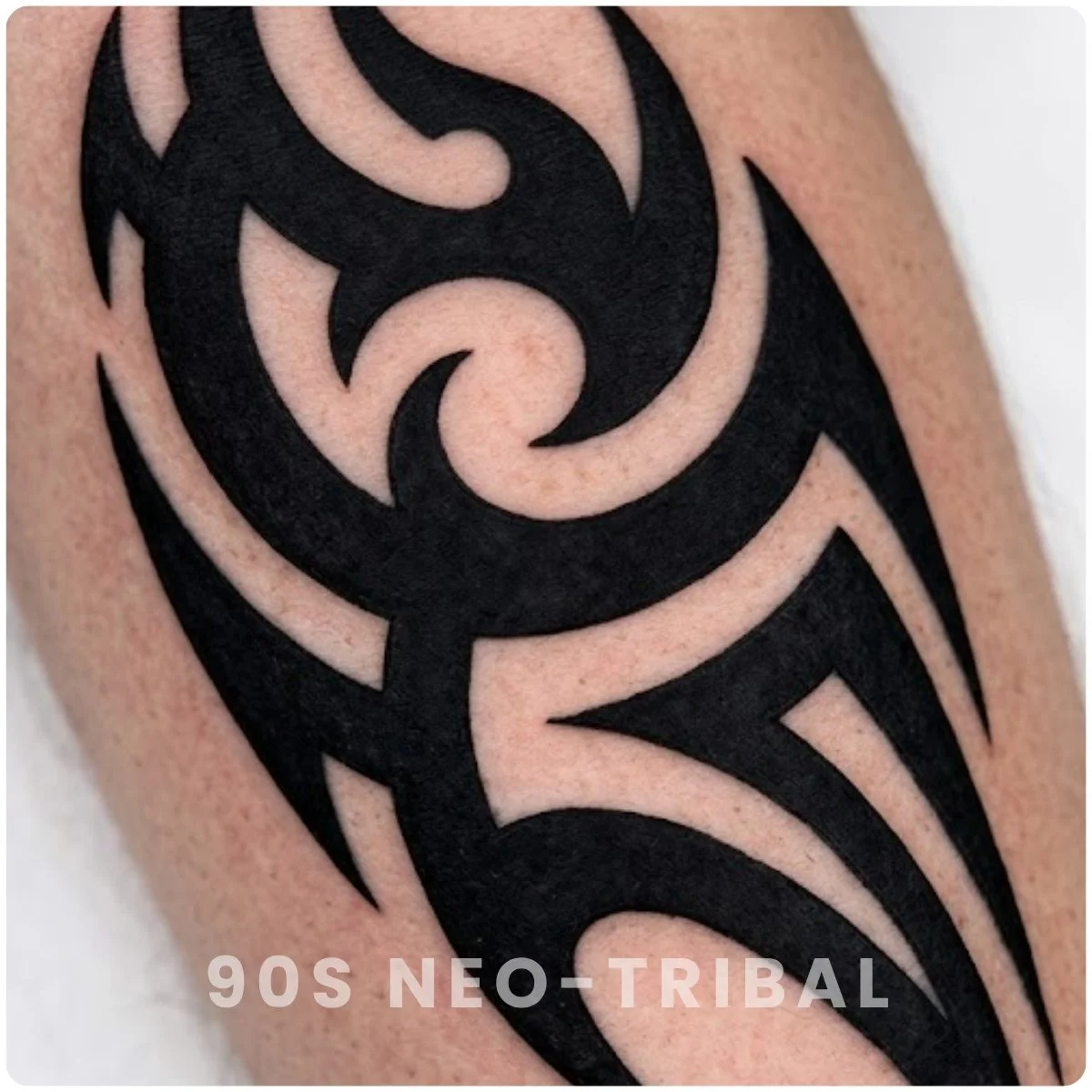
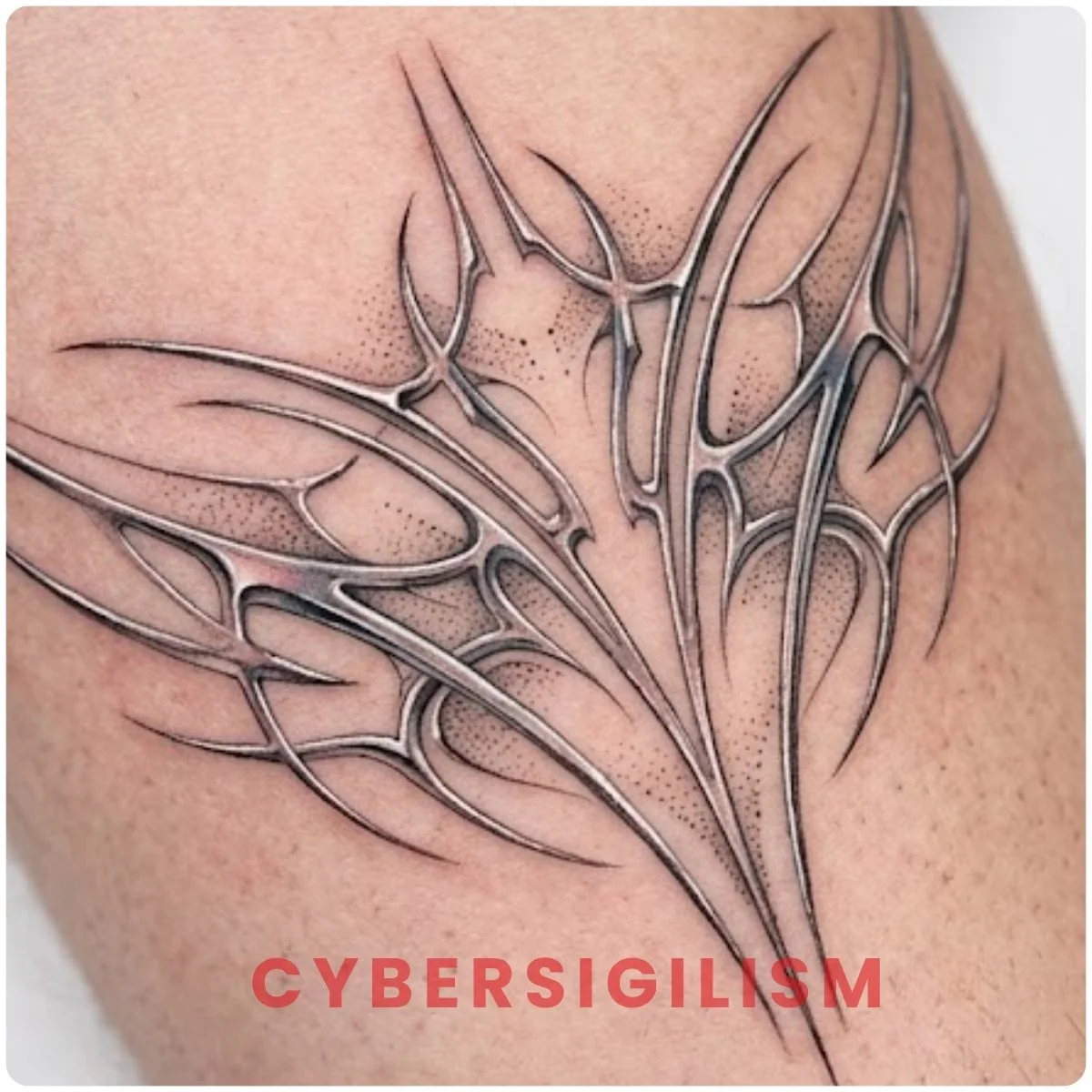
Respecting Cultural Lineage: Traditional Polynesian, Samoan, and Māori tattoos carry sacred ancestral status (Tatau). Cybersigilism is distinct because its visual roots stem entirely from modern technology, sci-fi media, and personal esoteric sigil creation.
Popular Design Motifs & 3D Tech Highlights
Cybersigilism is highly customizable, allowing collectors to embed hidden iconography within abstract linework. Because of its ability to contour gracefully along the body, this style has also become a major source of inspiration for women tattoo ideas, especially for sternum, collarbone, and spine placements.
Biomechanical Wings & Spines: Sweeping spiky linework running down the vertebrae or across the shoulder blades, creating a cybernetic armor effect.
3D Chrome & Metallic Highlights: Utilizing white ink highlights and soft grey-wash shading to make linework appear liquid, metallic, or three-dimensional on the skin.
Hidden Imagery: Abstract patterns that subtly conceal butterflies, daggers, cross motifs, or female silhouettes within the geometry.
Glitch & Digital Artifacts: Line breaks, micro-stippling, and binary-inspired dotwork simulating digital distortion.
Placement & Body Architecture: Designing for Movement
Because cybersigilism relies on long, continuous lines, placement dictates how well the tattoo ages and moves with your body:
| Placement | Aesthetic Advantage | Technical Aging Reality |
|---|---|---|
| Full Spine / Back | Expansive canvas allowing dramatic vertical symmetry and architectural flow. | Best Longevity: Low friction and minimal skin movement keep long fine lines straight. |
| Forearm & Upper Arm | Wraps around muscle contours, creating a "cybernetic limb" appearance. | High Longevity: Excellent visibility with minimal warping over time. |
| Sternum & Collarbone | Follows delicate bone structure with sharp, symmetrical S-curves. | Medium Longevity: Requires precise needle control over bony prominences. |
| Wrists, Hands & Fingers | High visual impact for Y2K micro-sigils and wrist cuffs. | High Maintenance: Friction and cell turnover require touch-ups every 2–4 years. |
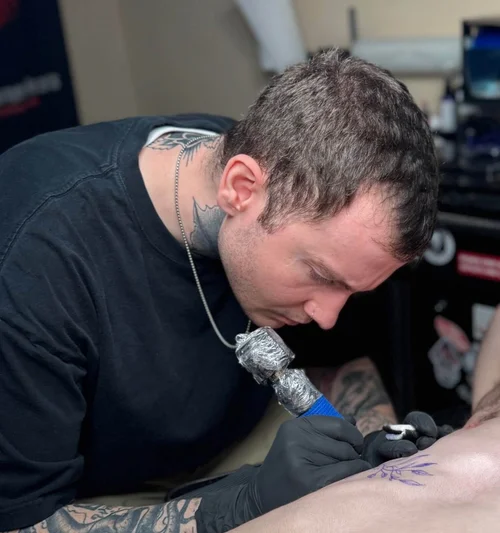
Collin Joiner
Expert Insight: Aging Mechanics of Fine-Line Cybersigilism
Executing ultra-fine cybersigilism requires technical mastery. Because sub-dermal ink particles naturally expand over time, improper linework will smudge.
"Cybersigilism leaves zero margin for error," explains a senior blackwork specialist at Burned Hearts Tattoo. "When working with 1RL and 3RL needle groupings for micro-spikes, if the ink is placed too deep in the dermis, it causes immediate blowouts. If placed too shallow, it fades during healing. The technical secret is calculating negative space—leaving enough breathing room between delicate parallel lines so that as the ink naturally matures over 10 to 15 years, the geometry remains razor-sharp rather than bleeding into a dark smudge." -Collin Joiner Burned Hearts Tattoo
Planning Your Cybersigilism Piece at Burned Hearts Tattoo
Whether you want a pre-drawn piece from our available flash tattoo collection or want to collaborate on large-scale custom tattoos, preparation is key:
Prioritize Anatomical Flow: Allow your artist to freehand key guide lines directly onto your body to match your muscle movement.
Respect Negative Space: Resist packing too many micro-lines into small areas; space is what keeps cybersigilism readable over decades.
Follow Meticulous Aftercare: Fine lines are highly sensitive during initial healing. Knowing exactly how to clean a tattoo ensures your delicate line weights are preserved without fading or blowing out.
Which Cybersigilism Tattoo Style Matches Your Aura?
Answer 4 questions to decode your ultimate sci-fi ink design.
1. What atmosphere or aesthetic dominates your visual taste?
2. How do you prefer linework and density on your skin?
3. What inspiration source appeals to you most?
4. Where would you place your piece for maximum impact?
Conclusion
Cybersigilism represents a powerful shift in modern body art—bridging the gap between ancient esoteric symbolic art and digital Y2K aesthetics. By swapping heavy blackwork fills for fine-line precision, razor-sharp nodes, and anatomical flow, this style turns the body into an organic, cybernetic canvas.
Because ultra-thin linework leaves no margin for error, bringing a cybersigilism piece to life requires an artist who masters needle depth, negative space, and long-term aging mechanics. When you are ready to transform your concept into a lasting piece of futuristic blackwork, schedule a consultation with the specialists at Burned Hearts Tattoo to design a custom layout built specifically for your body's movement.

Frequently Asked Questions
-
Because cybersigilism relies on ultra-fine line weights (1RL–3RL), aging depends on needle depth and negative space. Over time, sub-dermal ink naturally expands slightly. If an artist leaves adequate breathing room between lines and uses proper depth, cybersigilism stays crisp for 10–15+ years. Micro-lines placed too close together will eventually blur.
-
Traditional tribal tattoos (like Polynesian or Samoan Tatau) use heavy black ink blocks rooted in indigenous sacred heritage. 90s Neo-Tribal features bold, thick black curves. Cybersigilism strips away heavy black fills in favor of razor-thin lines, spiky geometry, 3D metallic highlights, and digital circuit aesthetics inspired by technology rather than cultural ritual.
-
Cybersigilism generally involves single-needle or fine-line needles, which cause less tissue trauma than large shaders or solid black packing. However, pain depends heavily on placement, spine, sternum, and collarbone placements feel more intense due to proximity to bone.
READ MORE…